哈希表 | 字数总计: 2.2k | 阅读时长: 10分钟 | 阅读量:
概述
哈希表(Hash Table)又称散列表,是一种通过键(Key)来访问值(Value)的数据结构。
通过某种计算将键值对映射到数组的某个位置/索引上,以此查找记录内容的过程称为哈希(Hashing),
实现将键值对映射到数组的某个位置的函数称为哈希函数(Hash Function)
简单图示
特性
场景
适用与精确查找的场景(给定一个键k,找到与k对于的值v)
不适用场景
具有多个相同键值对的记录场景
范围查找
最大最小键值查找
按键值顺序访问
哈希函数
负载因子
冲突
出现原因:出现不同键值使用哈希函数计算出来的哈希值是相同的
解决方法:开散列(Open Hashing)、闭散列(Close Hashing)
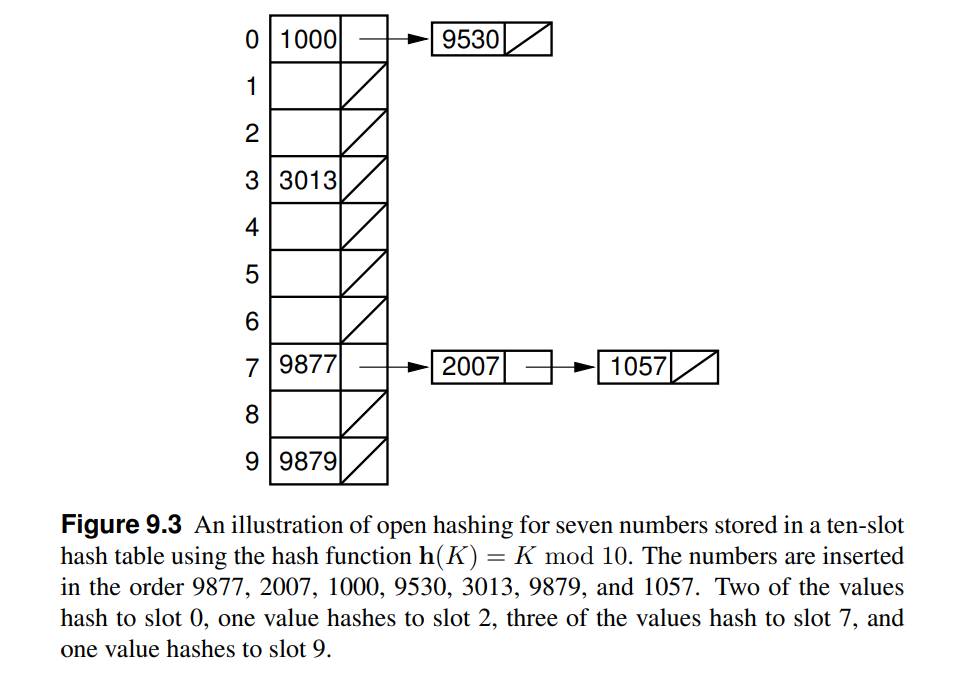
开散列法(数据存储位置是开放的,无数组大小限制)
拉链法: 在存放数据的地方开一个链表,相同索引的数据放到同一个链表中,查询的时候遍历列表获取数据
闭散列法(数据存储位置受数组范围影响)
如果发生冲突,就在冲突位置按照某种规则 ,往下继续查找,直到找到一处空位置为止,规则可以使用探测函数 p 表示(例如,发生冲突后的第 i 次探测表示: Pos(i) = (h(k) + p(k, i)) % M,其中,Pos 表示最终位置,h 为哈希函数,k 为键,M 为哈希表大小)
线性探查法:p(k, i) = i
Primary Clustering 问题(元素在物理层面连续,大量元素挤在连续内存中)
解决方法
改良线性探测: p(k, i) = i * c (c 为常数)
伪 随机: p(k, i) = random() (假设查找的元素是冲突元素,得获取原本的随机数才能找到元素,所以不能真随机)二次探测/平方探测: p(k, i) = i^2
Secondary Clustering 问题(元素在物理层面不一定连续,但是在探测函数上连续)
解决方法
双重哈希(Double Hashing): p(k, i) = i * h2(k)
删除元素时,将相关元素标记为 Tombstone(墓碑),在搜索时跳过,插入时覆写
桶哈希法
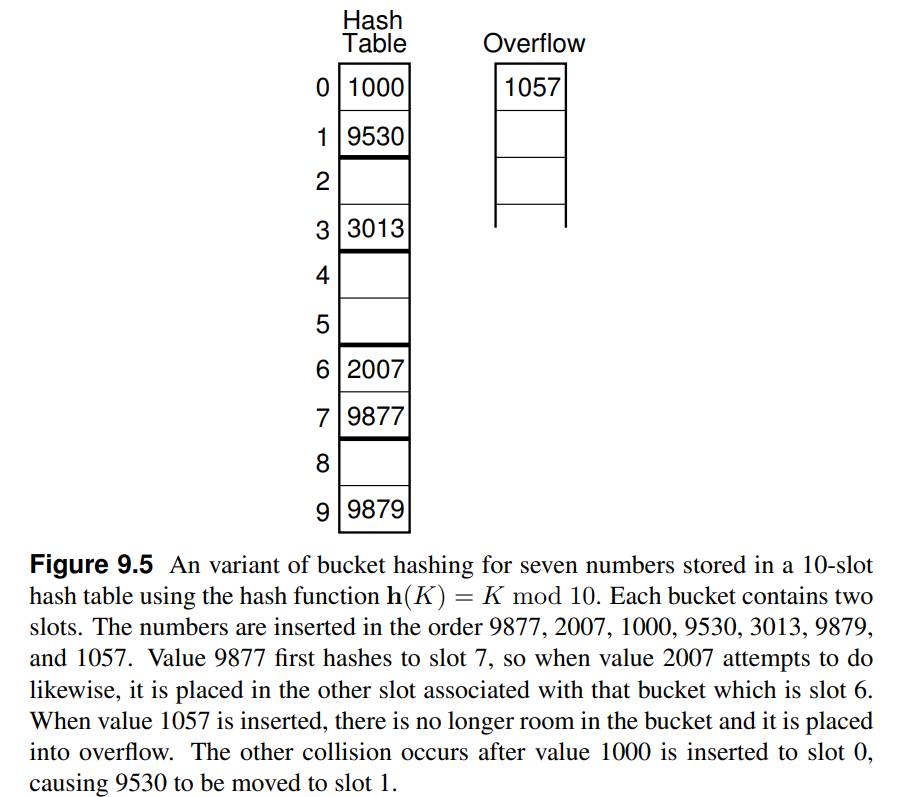
这个好像比较模糊,在教材 《Data Structures and Algorithm Analysis Edition 3.2 (C++ Version)》 —— Clifford A. Shaffer 中,把桶哈希归入闭散列法,但在网上也有开散列法的说法
将整个哈希表分为多个块,称为桶(bucket),每个桶内部有固定的槽位(slot)
键通过哈希函数映射到某个桶,槽位满了之后,存储到桶里的其它槽位
桶满了之后,按照设定规则处理(例如覆盖桶里的槽位)(教材给出了处理方式是,额外搞一个无限容量的桶来存储溢出的数据,这个地方有开散列的味道)
复杂度分析
操作
平均时间复杂度
最坏时间复杂度
查找
O(1)
O(n)
插入
O(1)
O(n)
删除
O(1)
O(n)
平均时间复杂度预设: 元素分布均匀
开散列法: O(1 + α \alpha α α \alpha α
闭散列法: O(1 / (1 - α \alpha α α \alpha α
最坏时间复杂度都是发生冲突导致的
开散列法: 所有元素都在一条链上
闭散列法: 数组聚集且塞满
发散/随想/自身理解(?)
C++ 中 std::unordered_map<>, std::unordered_set<> 底层是哈希表
核心是哈希函数(映射函数)
用的地方很多很多,对于精确查找的场景很方便
同样可以和其它结构和算法打组合拳,例如和双向链表组合搞 LRU
实现
ADT
1
2
3
4
5
6
7
8
9
10
11
12
13
class Hash {public : Hash () {} virtual ~Hash () {} virtual bool Insert (const int key, const int value) 0 ; virtual void Remove (const int key) 0 ; virtual bool Find (const int key, int & value) const 0 ; virtual int Size () const 0 ; bool Empty () return Size () == 0 ; } };
开散列法(拉链法)
1
2
3
4
5
6
7
8
9
10
11
12
13
14
15
16
17
18
19
20
21
22
23
24
25
26
27
28
29
30
31
32
33
34
35
36
37
38
39
40
41
42
43
44
45
46
47
48
49
50
51
52
53
54
55
56
57
58
59
60
61
62
63
64
65
66
67
68
69
70
71
72
73
74
75
76
77
78
79
80
81
82
83
84
85
86
87
88
89
90
91
92
93
94
95
96
97
98
99
100
101
102
103
104
105
class OpenHash : public Hash {public : OpenHash () { init (); } virtual ~OpenHash () { release (); } bool Insert (const int key, const int value) override return insert (key, value); } void Remove (const int key) override remove (key); } bool Find (const int key, int & value) const override return find (key, value); } int Size () const override return size; } private : struct Node { int key; int value; Node* next; Node (int k, int v, Node* n = nullptr ) : key (k), value (v), next (n) {} }; private : void init () hash_table.resize (INDEX, nullptr ); } void release () for (int i = 0 ; i < INDEX; ++i) { Node* cur = hash_table[i]; hash_table[i] = nullptr ; while (cur != nullptr ) { auto next = cur->next; delete cur; cur = next; } } } bool insert (const int key, const int value) Node* node = find_node (key); if (node != nullptr ) { node->value = value; return true ; } int index = hash_function (key); Node* new_node = new Node (key, value); Node* cur = hash_table[index]; new_node->next = cur; hash_table[index] = new_node; ++size; return true ; } void remove (const int key) int index = hash_function (key); Node* cur = hash_table[index]; if (cur == nullptr ) return ; if (cur->key == key) { hash_table[index] = cur->next; delete cur; --size; return ; } while (cur->next != nullptr ) { auto next = cur->next; if (next->key == key) { cur->next = next->next; delete next; --size; break ; } cur = next; } } bool find (const int key, int & value) const Node* node = find_node (key); if (node != nullptr ) { value = node->value; return true ; } return false ; } Node* find_node (const int key) const { int index = hash_function (key); Node* cur = hash_table[index]; while (cur != nullptr ) { if (cur->key == key) { return cur; } cur = cur->next; } return nullptr ; } int hash_function (const int key) const return (key % INDEX + INDEX) % INDEX; } private : static constexpr int INDEX = 10 ; vector<Node*> hash_table; int size{0 }; };
闭散列法(线性探查法)
1
2
3
4
5
6
7
8
9
10
11
12
13
14
15
16
17
18
19
20
21
22
23
24
25
26
27
28
29
30
31
32
33
34
35
36
37
38
39
40
41
42
43
44
45
46
47
48
49
50
51
52
53
54
55
56
57
58
59
60
61
62
63
64
65
66
67
68
69
70
71
72
73
74
75
76
77
78
79
80
81
82
83
84
85
86
87
88
89
90
91
92
93
94
95
96
97
98
99
100
101
102
103
class CloseHash : public Hash {public : CloseHash () { init (); } virtual ~CloseHash () { release (); } bool Insert (const int key, const int value) override return insert (key, value); } void Remove (const int key) override remove (key); } bool Find (const int key, int & value) const override return find (key, value); } int Size () const override return size; } private : enum Status { EMPTY, OCCUPIED, DELETED }; struct Node { int key; int value; Status status; Node (int k = INT_MIN, int v = INT_MIN, Status s = EMPTY) : key (k), value (v), status (s) {} }; private : void init () hash_table.resize (INDEX, Node ()); } void release () hash_table.clear (); } bool insert (const int key, const int value) int index = find_node (key); if (index != -1 ) { hash_table[index].value = value; return true ; } if (size == static_cast <int >(hash_table.size ())) return false ; index = hash_function (key); for (int i = 0 ; i < INDEX; ++i) { int pos = probe (index, i); if (hash_table[pos].status == EMPTY || hash_table[pos].status == DELETED) { hash_table[pos] = Node (key, value, OCCUPIED); ++size; return true ; } } return false ; } void remove (const int key) int index = find_node (key); if (index == -1 ) return ; hash_table[index].status = DELETED; --size; } bool find (const int key, int & value) const int index = find_node (key); if (index == -1 ) return false ; value = hash_table[index].value; return true ; } int hash_function (const int key) const return (key % INDEX + INDEX) % INDEX; } int probe (int base_index, int i) const return (base_index + i) % INDEX; } int find_node (const int key) const int index = hash_function (key); for (int i = 0 ; i < INDEX; ++i) { int pos = probe (index, i); if (hash_table[pos].status == EMPTY) { break ; } if (hash_table[pos].status == OCCUPIED && hash_table[pos].key == key) { return pos; } } return -1 ; } private : static constexpr int INDEX = 100 ; vector<Node> hash_table; int size{0 }; };
桶哈希
1 2 3 4 5 6 7 8 9 10 11 12 13 14 15 16 17 18 19 20 21 22 23 24 25 26 27 28 29 30 31 32 33 34 35 36 37 38 39 40 41 42 43 44 45 46 47 48 49 50 51 52 53 54 55 56 57 58 59 60 61 62 63 64 65 66 67 68 69 70 71 72 73 74 75 76 77 78 79 80 81 82 83 84 85 86 87 88 89 90 91 92 93 94 95 96 class BucketHash : public Hash {public : BucketHash () { init (); } virtual ~BucketHash () { release (); } bool Insert (const int key, const int value) override return insert (key, value); } void Remove (const int key) override remove (key); } bool Find (const int key, int & value) const override return find (key, value); } int Size () const override return size; } private : enum Status { EMPTY, OCCUPIED, DELETED }; struct Node { int key; int value; Status status; Node (int k = INT_MIN, int v = INT_MIN, Status s = EMPTY) : key (k), value (v), status (s) {} }; private : void init () hash_table.resize (BUCKET_COUNT, vector <Node>(SLOT_COUNT, Node ())); } void release () hash_table.clear (); } int hash_function (const int key) const return (key % BUCKET_COUNT + BUCKET_COUNT) % BUCKET_COUNT; } int find_in_bucket (const int key, const int bucket) const const vector<Node>& slots = hash_table[bucket]; for (int i = 0 ; i < SLOT_COUNT; ++i) { if (slots[i].status == EMPTY) { break ; } if (slots[i].status == OCCUPIED && slots[i].key == key) { return i; } } return -1 ; } bool insert (const int key, const int value) int bucket = hash_function (key); int slot = find_in_bucket (key, bucket); if (slot != -1 ) { hash_table[bucket][slot].value = value; return true ; } vector<Node>& slots = hash_table[bucket]; for (int i = 0 ; i < SLOT_COUNT; ++i) { if (slots[i].status == EMPTY || slots[i].status == DELETED) { slots[i] = Node (key, value, OCCUPIED); ++size; return true ; } } return false ; } void remove (const int key) int bucket = hash_function (key); int slot = find_in_bucket (key, bucket); if (slot == -1 ) return ; hash_table[bucket][slot].status = DELETED; --size; } bool find (const int key, int & value) const int bucket = hash_function (key); int slot = find_in_bucket (key, bucket); if (slot == -1 ) return false ; value = hash_table[bucket][slot].value; return true ; } private : static constexpr int BUCKET_COUNT = 10 ; static constexpr int SLOT_COUNT = 10 ; vector<vector<Node>> hash_table; int size{0 }; };